The Task and Accent Light Kit
Light the desk, the worktop and the picture on the wall from a fitting's own numbers: the center candela you can count on, the distance and slant it really works at, a lamp height set from the edge of the task, the beam chosen before the lumens, and a room layered instead of flooded
Luminosit's three most used calculators turn lumens into candela through the beam angle, candela into lux at a distance, and lumens into lux over an area. Each is right for what it assumes, and together they point toward more light than you will get: the converter treats a beam as evenly bright to its edge, though a beam angle marks where the light falls to half; the inverse-square law assumes the surface faces the light; and the corner of a page sits off the beam's axis. The kit carries those calculators through. In the worked study, a 500 lm, 60 degree desk lamp reads 594 cd on the converter and about 430 cd on a beam that fades to half at its edge, so the height the free tools give for 500 lux (1.08 m) lights the desk to 368 lux; set from the corner of the page, with the room's ambient light counted, the lamp goes at 0.69 m. A picture lit from the ceiling at 30 degrees takes half the light the facing law gives, so it needs 972 cd, a 36 degree spot of about 430 lm, where the free path buys 149 lm and no highlight at all. Layered over a 150 lux room, the study needs 59% fewer lumens than lighting it all to desk level. Every figure is computed by the site's own calculator code, and the worked numbers are examples. The beam model, the share of bulb light that lands and the room presets are labeled as a model and rules of thumb; the one standard quoted is EN 12464-1's 500 lux for reading and writing. Installing fittings is a licensed electrician's job; the kit chooses, aims and positions lights, swaps bulbs and plugs in lamps, and makes no health claim. 24 printable pages: seven steps, four working pages, two reference tables and a quickstart, plus a personalised sheet worked from the numbers in the calculator you came from.
Look inside
Two full pages from the kit, exactly as printed. Click either to read it at full size before you decide.
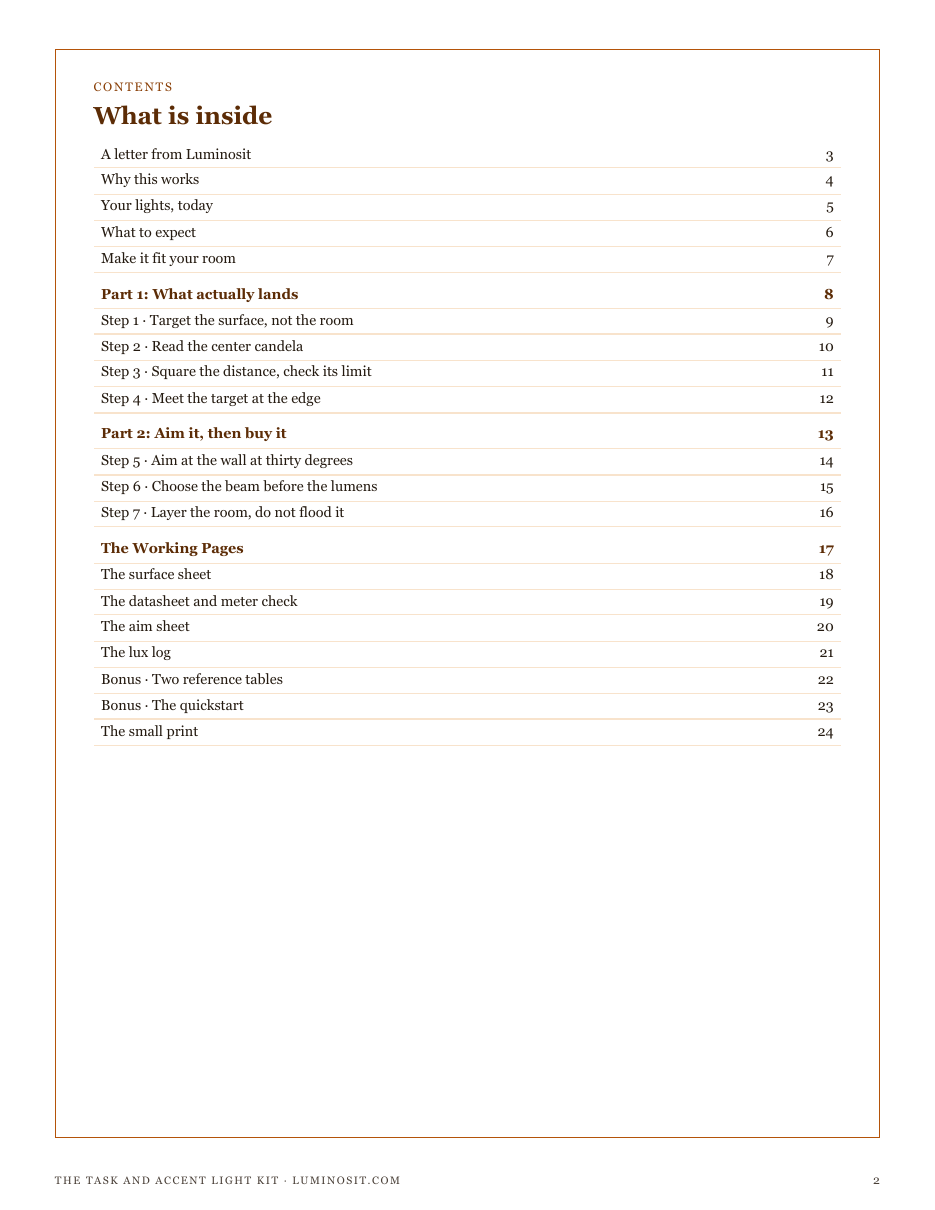
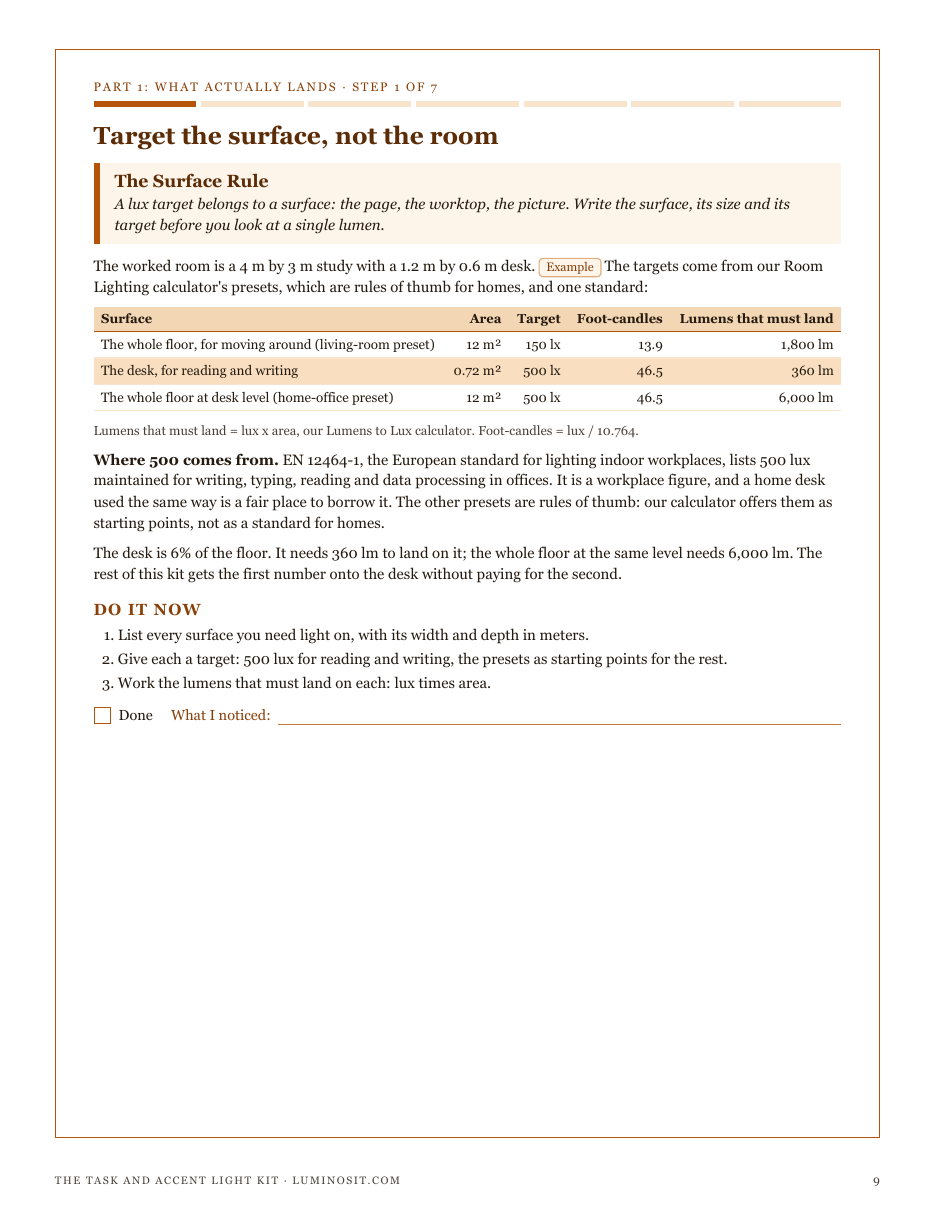
What is in it
- The Surface Rule: a lux target for each surface, and the lumens that must land on it
- The Center Candela Rule: the converter's figure knocked down for a beam that fades, or read from the datasheet or a meter
- The Five Widths Rule: the inverse-square distance, and where the law stops holding near a large light
- The Edge Rule: a lamp height set so the corner of the task meets the target, ambient light counted
- The Thirty Degree Rule: aiming a picture light from the ceiling, with the slant in the candela
- The Beam Before Lumens Rule: the narrowest beam that covers the subject, bought by center candela
- The Layer Rule: ambient light for moving around, task and accent light on top, and the running cost of each plan
- Working pages: a surface sheet, a datasheet and meter check, an aim sheet and a lux log
- Two reference tables: center candela and spot size per 100 lumens by beam, and lux and foot-candles at a distance
- A quickstart, and a personalised sheet worked from your own calculator inputs
- ✓ 24 printable pages
- ✓ 10 sections, worksheets and templates
- ✓ A second PDF worked out from the numbers you enter
- ✓ No account needed, just an email address
- ✓ Instant download; link valid 7 days
Price includes any taxes. Sold by GrabURL, who handle checkout and support. The charge appears on your statement as GrabURL.
The kit picks up where the free Lux at Distance Calculator leaves off. The calculator applies the inverse-square law to a surface that faces the light, at the center of the beam, with a candela you supply. Back-worked from lumens by the Candela to Lumens Calculator, that candela assumes a beam evenly bright to its edge, so it runs high; a picture on a wall takes the light at a slant; and the corner of a page sits off the axis. The kit reads the center candela from the datasheet or a meter, checks the distance against the size of the light, sets a desk lamp’s height from the edge of the task, aims a picture light at 30 degrees with the slant counted, chooses the beam before the lumens, and layers the room with the Room Lighting Calculatorinstead of lighting it all to desk level. Every figure in it is an example for you to replace. Installing or moving a fitting, track or dimmer is a licensed electrician’s job where you live; the kit chooses, aims and positions lights, swaps bulbs and plugs in lamps.